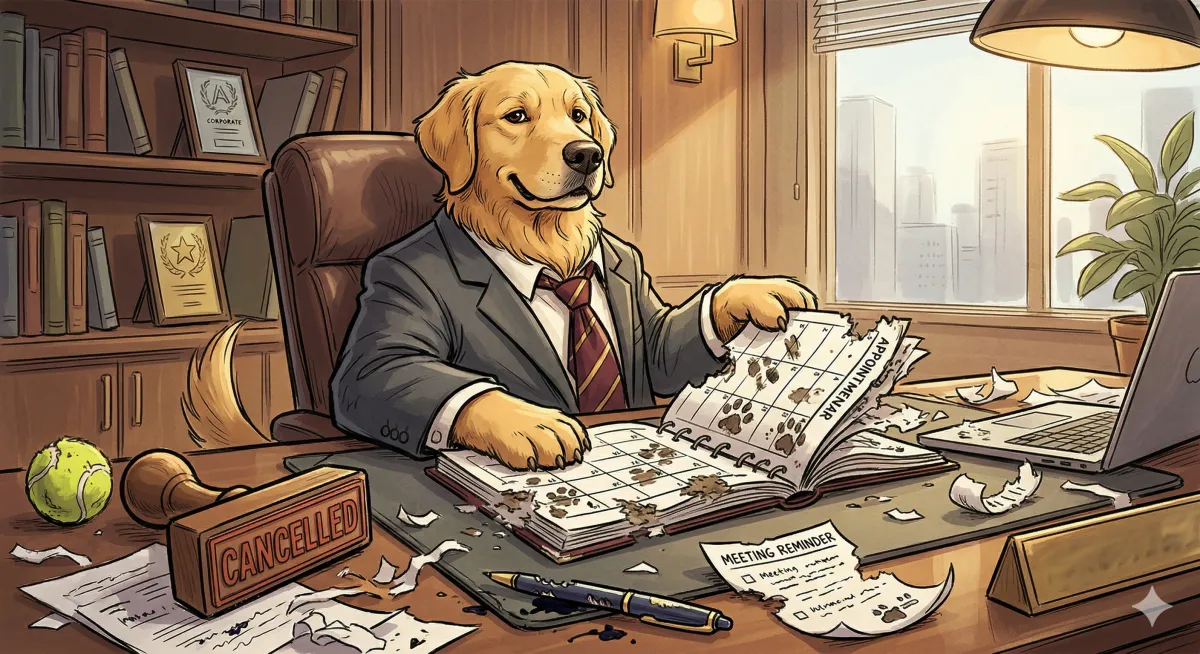
Did the Dog Eat Your Professionalism? What Financial Advisors Must Know About Client Experience and Cancellations
Did the Dog Eat Your Professionalism? What Financial Advisors Must Know About Client Experience and Cancellations
Why last-minute cancellations destroy trust, trigger client attrition, and silently wreck the client experience financial advisors work so hard to build.
There's apparently a canine catastrophe sweeping the nation, and nobody sent me the memo.
In the span of seven days, I've been on the receiving end of two of the most breathtaking cancellations of my professional career. Not because the people involved were incompetent or malicious, but apparently, we are living through the greatest dog-related crisis of our generation, and I am somehow ground zero.
Here's what happened.
Last week I was set to record a podcast. The host scheduled this weeks in advance. She goes radio silent until one minute past the start time. Then the email arrives. Sincere apologies. Her dog got lost from daycare the day before and needed a vet visit. Could we reschedule?
I want you to sit with that for a second. The dog went missing yesterday (and was found a couple hours later). Not this morning, yesterday. There was an entire night between the dog crisis and our scheduled recording. At no point during that evening did it occur to her to say, "I should probably handle this before it becomes someone else's problem."
But wait. It gets richer.
This week I had a meeting scheduled with a vendor. I get the cancellation email a few hours before we're supposed to connect. The reason? Their dog suddenly passed away over the weekend. And they're closing on a house tomorrow.
I'm genuinely sorry about the dog. Losing a pet is devastating, and I mean that with zero sarcasm. But here's the part that breaks my brain: the dog passed over the weekend. The house closing is tomorrow. And it somehow didn't occur to this person, at any point between Sunday afternoon and Monday morning, to block their calendar so a meeting didn't sneak up on them like a surprise bill from the IRS?
That's not grief, but a systems failure dressed up in grief's clothing.
So here's the question I can't shake: Is there a pandemic going on with dogs? Or did the dog eat your calendar, your professionalism, and your basic sense of what it means to respect someone else's time?
Why Do Clients and Prospects Cancel Last Minute? (And Why It Costs You More Than the Meeting)
Look, I've owned home service businesses for nineteen years. I've had employees call in sick. I've had trucks break down on the side of the road. I've had days where everything that could go wrong absolutely did, with gusto. Life doesn't care about your schedule.
But here's what I learned the hard way, running crews on people's property where a no-show doesn't just irritate someone, it costs you a five-hundred dollar job and a lifetime customer: the excuse is never the real problem.
The real problem is the absence of a system that protects your commitments when life goes sideways.
Disney taught me something I've never forgotten. The show must go on. Not because Cast Members don't have personal lives. They absolutely do. But Disney understood that the guest standing in front of you has no idea what's happening backstage, and frankly, they don't care. They saved up for years, drove six hours and they're there. And your backstage chaos is not their burden to carry.
Heartless? Hardly. That's what professional client experience actually looks like.
What Does a Last-Minute Cancellation Actually Signal to a Financial Advisory Client?
Here's the question I want every financial advisor and wealth manager reading this to sit with before getting defensive.
When a client calls in a panic because the market just dropped four hundred points, do you pick up? Or do you call back two hours later with a perfectly crafted voicemail that sounds empathetic but delivers nothing?
When a client's spouse passes away and they need to restructure their entire financial picture, do you show up with a clear plan and a calm presence? Or do you reschedule because you've got something going on?
I'm not asking if you care, as I'm sure you do. I'm asking if you have a system that proves it, regardless of what's happening in your personal life on any given Tuesday.
Here's what most advisors don't want to hear: your clients are watching everything. Every late callback. Every vague email. Every "let me look into that and get back to you" that takes three days. They're tallying it. Not consciously, maybe. But it's going into the ledger.
And the day the market gets ugly, or they get a competing pitch over lunch at the club, they're going to open that ledger. They're going to remember how it felt when you weren't there. And they're going to wonder if you're really the person protecting their retirement, or just the person managing their assets until someone more reliable comes along.
How Cancellations Directly Impact Client Retention for Financial Advisors
Client attrition in financial services rarely happens in a single dramatic moment. It happens in a slow accumulation of small disappointments that never individually cross the threshold of a conversation, but collectively create a client who is quietly open to leaving.
A last-minute cancellation is one of those moments. So is the delayed callback. The generic apology email. The recovery message that pivots straight into a pitch.
I wrote about this in my book. I had a salesperson blow off a scheduled meeting with me. Three weeks went by. Then he sent me a one-sentence half-apology and launched straight into his pitch. Eleven sentences total. One about me. Ten about him. I passed on the business and told him exactly why. His response was that he'd confused my company with someone else's and deleted me by accident. That made me feel spectacular.
The point isn't that he made a mistake. Mistakes happen. The point is that his recovery was so embarrassingly self-centered that it erased any chance of salvaging the relationship. He apologized like he was checking a box, not like he understood what he'd actually done.
That's the moment where the real character of a firm reveals itself. Not when things go perfectly. When something breaks.
What Is a Client Experience System, and Why Do Financial Advisors Need One?
A client experience system is a set of repeatable, documented protocols that govern every touchpoint a client or prospect has with your firm, including what happens when things go wrong.
Disney doesn't wing it. Not a single part of what guests experience at Walt Disney World happens by accident or on the fly. Every interaction, including the recovery from a problem, follows a practiced, replicable system. The magic isn't improvised. It's engineered.
Your firm needs the same thing.
Here's what that looks like in practical terms for a financial advisory practice.
Scheduling commitments are treated as promises, not preferences. When you put something on the calendar, that block is sacred. If your life suddenly makes it impossible to keep, your first move is not to send an apologetic email at T-minus two hours. Your first move is to pick up the phone before the meeting time. Not at start time. Before.
Every firm needs a contingency protocol for life's inevitable disruptions. Your dog is sick. Your basement flooded. Your kid is running a fever. What's the plan? Who covers? What's the communication chain? If you don't have a documented answer to that question right now, you don't have a client experience strategy. You have a hope strategy.
The apology and the ask are two separate transactions. When you cancel on someone, you owe them a genuine acknowledgment that you disrupted their day. That's the entire transaction for that moment. The rescheduling ask comes separately, after they've had a second to breathe. Showing up with your apology in one hand and your calendar link in the other is not remorse. That's efficiency wearing a costume.
Track your reliability metrics. How many times in the last six months have you cancelled, rescheduled, or been late to a client-facing commitment? If you don't know the answer, the number is probably higher than you're comfortable admitting.
What Do High-Net-Worth Clients Expect When a Financial Advisor Makes a Mistake?
High-net-worth clients and the prospects who could become them don't expect perfection. They've built enough in their own lives to understand that the world is messy. What they expect is that when you drop the ball, you pick it up faster and more gracefully than anyone else in their life would.
That gap is your competitive advantage. Not your investment philosophy. Not your fee structure. Not the framed credentials on your office wall.
The moment a client thinks, "He called me before I even knew there was a problem," or "She handled that so well, I actually feel better about this firm now than I did before the issue happened," that's retention. That's the referral that happens without you asking for it. That's the account that doesn't move when the next recession rolls through and the wolves start circling.
When I was at Disney, we had a saying: there's no such thing as "off stage." The moment you put on the costume, you are the character. Period. A guest doesn't get to have a bad experience because Cinderella had a rough morning.
Your firm works the same way. You don't get to have a client-facing moment that's off brand. Not a cancellation. Not a late reply. Not a perfunctory apology followed immediately by a sales pitch.
The Three Non-Negotiable Rules of Professional Commitment for Financial Advisors
Rule One: Own the recovery completely. A sincere apology is not a weakness. It's a trust deposit. Do it without excuses, without mixed messages, and without a pivot to your pitch. A client who feels genuinely heard after a disappointment often becomes a more loyal client than one who never experienced a problem at all.
Rule Two: Build the backstage so the front stage never wobbles. Your clients don't need to know what's happening in your personal life. They need to know that their financial future is in the hands of someone with a system strong enough to show up even when life gets complicated.
Rule Three: Measure what matters. Cancellations, late responses, missed callbacks. These are your early warning system for client attrition. Track them the way you'd track AUM or revenue. They're just as real a number.
The Bottom Line: Your Clients Are Keeping Score
I'm going to close this the same way I ended up after both of those magnificent dog-related cancellations this week.
Life happens. Dogs pass. Deals close. Pipes burst. I get it.
But if you want to be trusted with someone's financial future, their retirement, their legacy, you don't get to let your backstage chaos become their front stage problem.
Block the day. Make the call. Own the moment.
Because your clients are absolutely, positively keeping score.
And the dog ate your homework is not a client retention strategy.
Vance Morris is the Only Disney Experience Direct Response Marketer on the Planet and founder of the Deliver Service Now Institute. He helps financial advisors and wealth managers build client experience and retention systems that create fierce loyalty, eliminate attrition, and drive enterprise value. Learn more at DeliverServiceNow.com.


