How Do Financial Advisors Keep Clients After Death, Divorce, or Incapacity?
How Do Financial Advisors Keep Clients After Death, Divorce, or Incapacity?
(Death, Divorce, Incapacity—and Why Most Advisors Lose the Relationship Anyway)
By Vance Morris
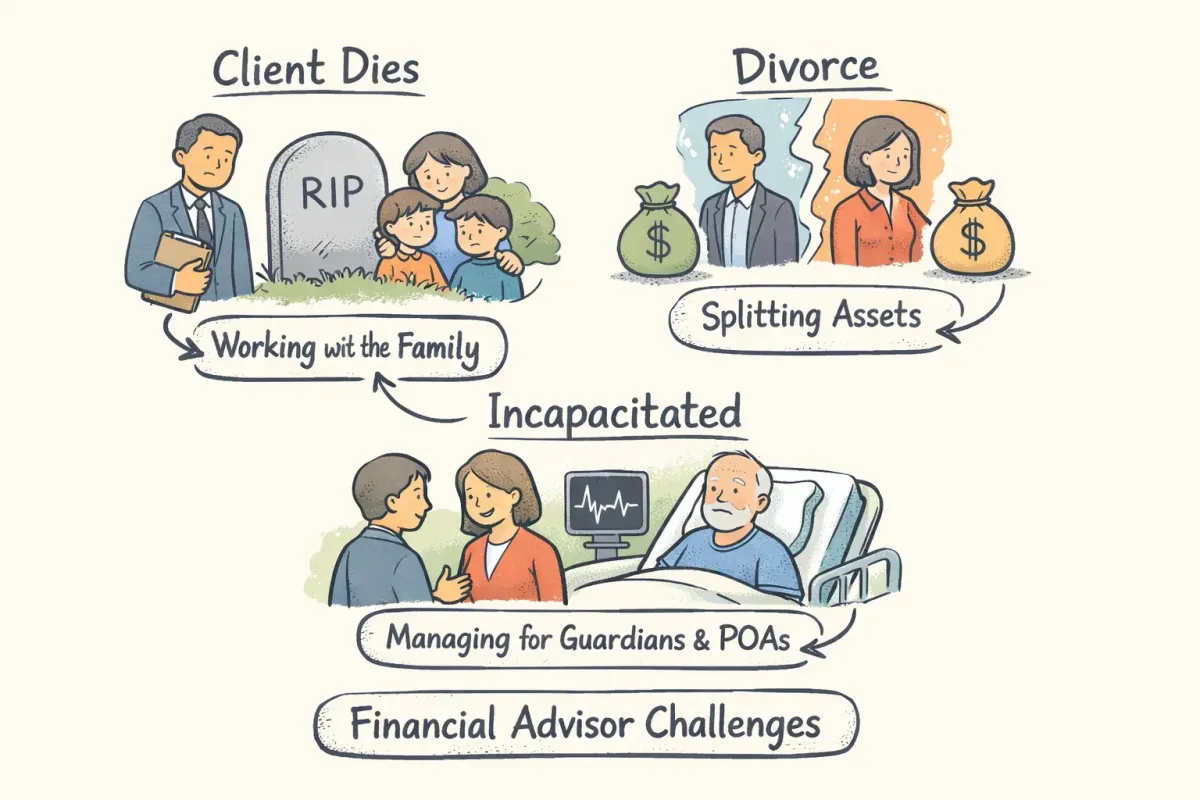
Most financial advisors think they lose clients because of performance, fees, or bad advice. They lose them when life shows up uninvited.
Death.
Divorce.
Incapacity.
That’s when everything gets tested. Not your portfolio… your relationship. And in my experience, most advisors fail that test.
Why Understanding These Moments Actually Matters
These aren’t edge cases, but inevitabilities. And how they’re handled determines whether:
assets stay
relationships survive
or everything walks out the door to a new advisor who just happened to show up at the right time
You can be technically perfect…
…and still lose the client.
This isn’t about your technical skill, but about how trust moves or doesn’t.
How Relationship “Transfer” Actually Works
When life changes, control shifts. Not emotionally. Legally. And the system doesn’t care how great your quarterly reviews were. Custodians follow:
account titles
beneficiary designations
legal documents
Not loyalty. Not history. Not how long you’ve “worked together.” If trust isn’t already embedded beyond you…
…it doesn’t transfer.
What Happens When a Client Dies
(Heirs, Executors, and the Reality Check)
When a client dies, the custodian doesn’t ask, “Who had the best relationship?” They look at paperwork.
Beneficiary designations override wills
Joint accounts pass automatically
Everything else goes through probate
To move anything, custodians typically require:
certified death certificate
letters testamentary or trustee certification
ID for the new owner
account transfer forms
Until that’s verified? Trading usually stops, access slows down and your “relationship” is now sitting in limbo while the family decides what to do next. You can assist:
inventory holdings
identify tax lots
coordinate with estate counsel
But here’s the real question:
👉 Does the family even see you as their advisor?
Because if they don’t, you’re just a temporary placeholder. Processing can take days… or weeks. Want to speed it up? Have:
certified documents ready
executor or trustee clearly identified
estate counsel looped in early
That’s operations. But retention? That was decided long before the death.
When Divorce Hits
(Splitting Assets—and Usually the Relationship Too)
Divorce doesn’t just split assets, it splits trust. Ownership changes based on state law:
Community property → roughly 50/50
Equitable division → based on circumstances
Retirement accounts often require a 👉 qualified domestic relations order (QDRO) to avoid tax disasters.
Here’s where advisors get into trouble. When both spouses are clients, things get messy, fast.
You’ve got:
conflicting interests
emotional landmines
legal exposure
Smart move?
disclose conflicts immediately
pause joint planning when needed
recommend independent counsel
Put it in writing:
who you represent
when services stop
when separation is required
After the dust settles:
confirm new account titles
clarify fees
define who continues with you
But let’s not pretend. Most of the time? You don’t “retain both.” You’re lucky if you retain one.
When a Client Becomes Incapacitated
(Who Actually Has Control?)
Now we’re in dangerous territory. Because if nobody planned for this… everything slows to a crawl.
Two main paths:
Durable Power of Attorney (POA)
Named agent acts immediately
No court involvement
Guardianship / Conservatorship
Court-appointed
Slow, expensive, messy
Custodians typically want:
original or certified POA
proper notarization
sometimes additional institutional verification
Before you move a dollar:
confirm it’s durable
check for revocation
verify with the drafting attorney if needed
Also:
require ID from the agent
watch for unusual activity
question anything that smells off
If something feels wrong? Stop. Refuse instructions and report it if necessary.
Because at this stage, you’re not just an advisor, you’re a gatekeeper.
What Actually Determines If the Relationship Survives
Let’s cut through it.
It’s not:
performance
reporting
your charming personality
It’s whether the relationship was built to survive you.
The Three Types of Advisor Relationships
Performance-Based
Built on returns
Looks strong
Collapses under stress
Service-Based
Responsive, helpful
Better… but still fragile
Experience-Based
Multi-person trust
Emotional connection
Survives life events
Most advisors live in the first two. The third is where retention actually happens.
The Variables That Decide the Outcome
Just like brewing coffee, small variables change everything.
Here, it’s:
involvement of spouse and heirs
frequency of meaningful communication
clarity of roles during transitions
documented continuity plans
proactive touchpoints before life events
Ignore these…
and you’re gambling with your book.
The Myths That Are Costing Advisors Millions
Let’s clear this up.
“Great performance keeps clients.” No. It keeps them… until something happens.
“Good service builds loyalty.” No. It builds satisfaction, not attachment.
“Clients are loyal.” No. They’re loyal to certainty, clarity, and comfort.
Lose those? They’re gone.
Choosing an Advisor Who Can Actually Handle This
If you’re evaluating an advisor, or positioning yourself as one, this is where it matters.
Credentials help:
CFP® → broad planning expertise
RIA → fiduciary obligation
Groups like NAPFA often signal fee-only models, but verify everything.
Fee structure matters more than people admit:
AUM can drop when assets split
Flat or hourly is easier to carry across transitions
Commissions can complicate everything
If you want a breakdown of how advisors actually price their services,
see this analysis.
Continuity is the real differentiator.
Ask:
Is there a written succession plan?
Who is the backup advisor?
Have they met the spouse or heirs?
Or is everything sitting in one person’s head?
For a deeper look at operationalizing this, see Vance Morris | Architect of XPerience Service Systems for Wealth Advisors.
The Vetting Checklist (Use This or Pay Later)
Ask directly:
“Are you a fiduciary 100% of the time?” Get it in writing.
For a plain-English breakdown, see what is the fiduciary duty.
“What happens if you disappear tomorrow?”
There better be a name, a process, and an introduction.
“Can I see your continuity plan?”
If they hesitate… that’s your answer.
Red Flags That Should Make You Walk
No succession plan
Vague fiduciary answers
Heavy reliance on commissions
Too many clients, not enough structure
Refusal to include spouse or heirs
Quick scoring:
Must-haves:
Written fiduciary status
Documented succession plan
Spouse/heir inclusion
Extras:
Backup advisors
Team structure
Fee transparency
Client references
Miss the must-haves?
Move on.
Where to Find Better Advisors
Start with:
CFP Board
NAPFA
XY Planning Network
Paladin Registry
RIA firms with published fees
For curated fee-only options, see the Flat Fee Advisors directory.
The 72-Hour Reality Checklist (After Life Hits)
When something happens, speed matters.
Within 72 hours:
notify advisor and custodian
secure death certificates
gather wills and trust docs
confirm executor or trustee
freeze unnecessary transfers
schedule a planning call within 10 business days
Bring:
account numbers
beneficiary forms
POA or trust documents
Delays cost money and confusion costs relationships.
What This Means for Your Practice
Death, divorce, and incapacity don’t just change accounts.
They change control.
Beneficiaries dictate flow
State law dictates splits
POAs or courts dictate authority
If this isn’t documented and systemized…
your team will hesitate.
And hesitation is where assets leak.
For deeper guidance on retirement splits, see qualified domestic relations orders (QDROs).
Where Most Advisors Lose the Game
Not in the markets.
In the moments that matter.
when heirs don’t know them
when spouses aren’t included
when no one knows what happens next
That’s when relationships fracture and when accounts move.
If you want a wake-up call, read Why Your Clients Feel Replaceable 02.19.26
And if you think authority is guaranteed in today’s world… it’s not. See "Botox" Killing Your Financial Advisory Authority.
The Move Most Advisors Avoid (And Pay For Later)
Audit your top ten clients right now.
Are beneficiaries current?
Is there a durable POA?
Has the spouse met you?
Do heirs know your name?
If not…
you don’t have a client relationship, but a temporary arrangement.
Legal authority decides who controls the account. But experience… systems… and communication?
That’s what decides whether you’re still in the picture when it matters.


